CCU
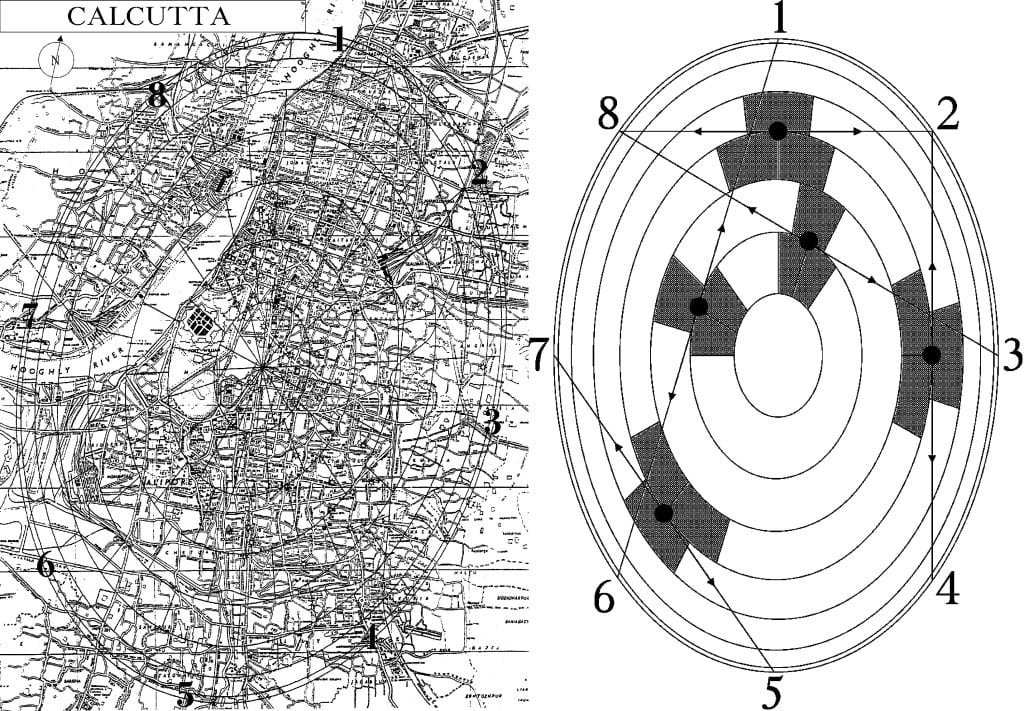
CCU map & diffusion
West German Radio Cologne: On CCU (1980):
Calcutta was founded in 1697 by the British; two centuries later it became the second largest city in the British Empire, growing further into a metropolis of twelve million today. Few other cities are home to so many world religions: not only Hinduism but also various Islamic, Christian and Buddhist sects as well as Sikhism, Jainism, Judaism and Zoroastrianism all have a place there. Calcutta is also an important cultural centre with a strong sense for the muses running right through all levels of society. It is also one of the most important centres of North Indian Classical Music. Contributing to the cultural richness of this capital of Bengal are several peoples not only from India but also from Tibet, China and Armenia.
The Cologne composer Clarence Barlow, who was born in Calcutta, made a large number of recordings in that city from November 1977 until February 1978 for the West German Radio; in 1980 he assembled a rich selection of these recordings to form an acoustic portrait of Calcutta. The position in time of events in CCU, as the piece is called, correspond to the time of day at which these were recorded (irrespective of date) in such a way, that twenty-four hours are reflected in forty-eight minutes, i.e. each minute of the piece corresponds to one half-hour of a hypothetical day in Calcutta.
This eight-channel recording was mixed according to the following principle: the eight loudspeakers, placed in a circle, correspond to points of the compass on the periphery of the city - the circle's centre corresponds to the city's centre (set at the crossing of Middleton Street and Nehru Road). Each of the original stereo recordings is panned to a pair of loudspeakers in such a way, that the midpoint of the line joining the two speakers would match the direction and distance from the city centre of the place of recording. The letters CCU form the international abbreviation for Calcutta Airport.
